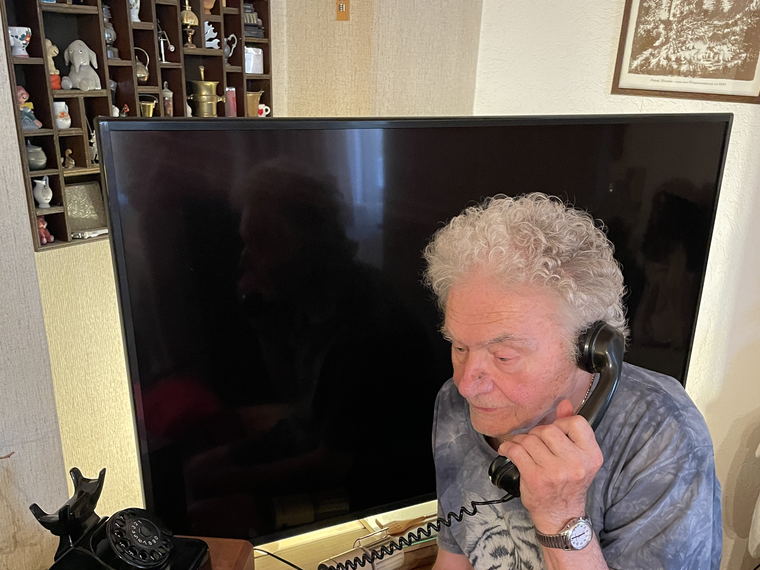
Meet Paul
Build logSomeone checks in.
Every day.
A rotary telephone with a patient voice inside. For the parent who can't manage a screen, and the son or daughter who can't call every day.

Why a telephone
The hard part was never the AI. It was physics.
A voice from a speaker across the room is close to the hardest possible way for someone with age-related hearing loss to receive speech. A handset held against the ear delivers it directly, at close range, and works alongside a hearing aid. It needs no eyesight at all.
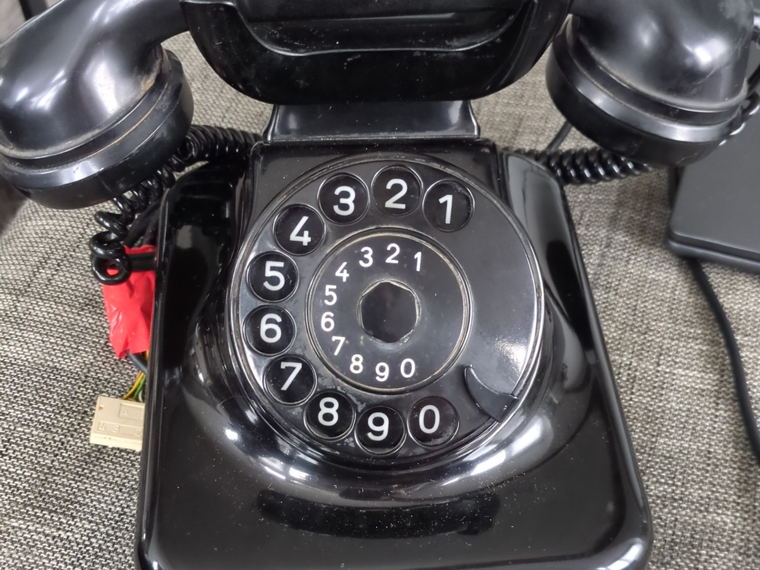
And there was already one in the flat: a rotary telephone Paul had used competently for sixty years. He is 93, almost blind, hard of hearing, and completely lucid. Nothing about this object needs to be learned.
The whole interface
Lift the handset. Talk. Put it down.
-
Nothing else to operate
The receiver up begins a call; the receiver down ends it. Until it is lifted, the microphone is doing nothing at all — a privacy model enforced by a leaf switch from the 1960s.
-
It waits
Older voices pause mid-sentence to assemble the rest of a thought. The phone treats those gaps as thinking, never as its turn to talk, and it never fills a silence just to hear itself.
-
It remembers, carefully
The same garden, the same family, the same story he likes to tell. A fact it merely overheard stays provisional, and nothing alarming it might have misheard is ever believed without asking first.
The part you can't screenshot
It waits longer than you're comfortable with.
Older people leave real gaps in the middle of a thought. Every voice assistant we tested hears a gap and takes its turn. Below is the same four seconds this phone tolerates, at the speed it actually happens.
- Renate „Der Markt in der Altstadt war heute, nicht wahr?” “The market in the old town was today, wasn't it?”
- He begins „Ja… ich war da, mit meiner…”
- Silence Four seconds. He is assembling the rest of the sentence. A system tuned for our speech has already started talking over him.
- He finishes „…mit meiner Tochter. Es war schön.” “…with my daughter. It was lovely.”
- Renate „Das klingt nach einem guten Nachmittag.” “That sounds like a good afternoon.” — and then nothing. No question, no prompt. His turn, for as long as he wants it.
A demonstration of the turn-taking, not a recording of a call. Renate is the voice on the phone; the real recordings stay between him and his family.

Ten holes, no menu
Sixty years of muscle memory.
Dialling 0 takes longer than dialling 1 — the wheel travels further, which is why old exchanges gave the operator the slowest number. None of that has to be explained to someone who has done it since 1962. That is the entire argument for the object.
The wheel here is dialling 0 6 · 0 6: 6 June 2026, the day the phone went into his flat.
From the workshop
The build log.
Notes written as we go, including the parts that didn't work.
-
Six weeks of calls with Paul
What one real user taught us that no amount of design could have: the pause, the silence problem, and why the AI must never believe what it mishears.
Read -
Assembling the phone
A Raspberry Pi, a handset, and the discovery that the audio path, not the AI, was the entire project.
Read