Build log · 02
Six weeks of calls with Paul
What one real user taught us that no amount of design could have: the pause, the silence problem, and why the AI must never believe what it mishears.
One user is not a study. But one user, every day, for six weeks, will find things that no amount of internal testing ever will, because we are not 93, and the failures that matter are not the ones we know how to look for.

Who it's for
Paul is 93. He is the grandfather of one of us. He has about ten per cent of his sight left, and he struggles to hear even with a hearing aid.
The important thing about him, the thing that makes this worth building at all, is that he is completely lucid, and always has been someone who needs to know what is going on in the world. He hasn't lost his interest in anything. He has lost the means to get at it. Over a few years he lost the telephone, the television, and the ability to follow a conversation in a room, more or less at once.
The barrier is not the AI, and it is not willingness. It is that nearly every product in this market assumes a user who can see a screen and hear a room.
The setup
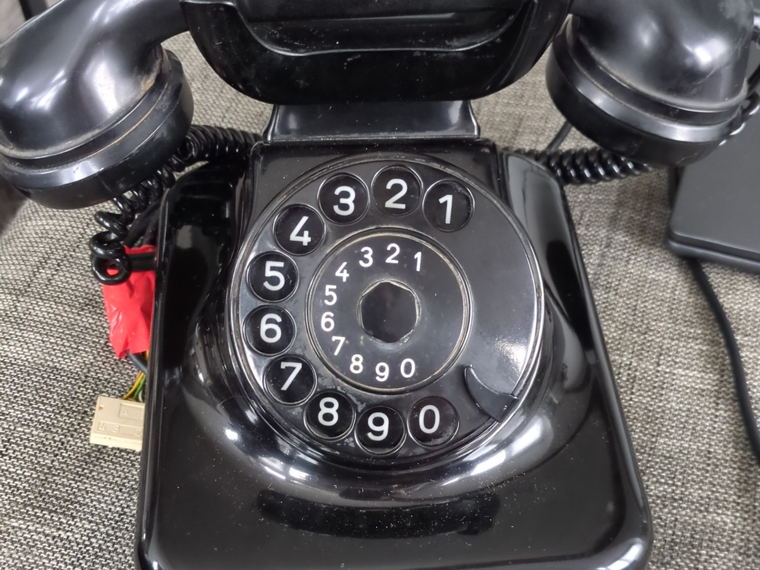
The first device went into his flat on 6 June 2026. He lifts the handset and talks; he puts it down and the call ends. There is nothing else to operate.

He uses it for roughly ten minutes at a time, almost every day. He knows the calls are recorded and reviewed, and has agreed to it. We go through them each week, and the device has changed nearly every week since as a result. Everything below came out of that review, not out of a roadmap.


1. The pause
The first recordings were painful to listen to. He would begin a sentence, pause to assemble the rest of it, and the assistant would take the pause as its turn and start talking. He would stop. It would keep going. He'd try again.
Every voice assistant we tested does this, and it isn't a bug in any of them. They are tuned to the rhythm of people our age, who speak in a more or less continuous stream. Older people talk more slowly and leave real gaps in the middle of a thought. A system tuned for us reads those gaps as "finished."
So turn-taking became far more patient. Long silences in the middle of a sentence are tolerated rather than treated as an end of turn, and there is a separate, much longer idle timer, around half a minute, before the assistant gently restarts a conversation that really has stalled. It waits, and if the silence goes on, it warmly brings up something he cares about rather than asking "are you still there?"
None of this appears on a spec sheet. It is also, we think, the single thing that decides whether someone uses the device a second time. Being interrupted is humiliating. Being interrupted by a machine is what puts the machine in a drawer.
2. Silence is failure
On a screen, a spinner buys you three seconds of patience. On a telephone with no screen, there is nothing whatsoever to indicate that the device is working. A few seconds of dead air and the only available conclusion is that the line has dropped, so he hangs up.
This turned "make it fast" from an engineering nicety into a hard requirement, and it changed the architecture in two places.
The news is fetched before he asks for it. Every morning at six, the phone collects national headlines and (this is the part he actually cares about) searches for local news and events in his own town. It caches all of it. When he asks what's going on, the answer is already sitting there. The local events are kept as a rolling agenda that expires by date, which has a nice side effect: the day after something happens, the assistant can ask him how it was.
When it genuinely has to go away, it says so with sound. Anything that needs a live web search plays hold music. Not because hold music is pleasant, but because on a telephone, something has to occupy the line or the call is over.

3. It must not believe what it mishears
This was the one that genuinely worried us.
His handset is imperfect and his speech is quiet, so a fraction of what reaches the model is garbled. And a language model handed garbled audio does not say "I didn't catch that." It finds the nearest plausible sentence. In our recordings that occasionally meant it invented an alarming subject out of noise: weapons, war, an accident, illness, death. And then, being a caring assistant, it responded with concern to a thing he had never said.
That is worse than useless. It is frightening an elderly person on the basis of a transcription error.
The rule is now absolute and lives in a part of the prompt that cannot be edited away from the dashboard: never act on a possibly-misheard alarming word. Ask first. And when what arrives is plainly not speech, it says exactly that, gently, and invites him to try again:
“Ich habe gerade nur ein Rauschen gehört. Sagen Sie es bitte noch einmal langsam und deutlich, dann bin ich ganz bei Ihnen.”
“I only heard static just now. Say it once more, slowly and clearly, and I'm right here with you.”
Note what that sentence does not do: it doesn't blame him, and it doesn't say "error." When an older adult hits an error, they tend to blame themselves: I broke it, I'm too old, I'm stupid. That shame is what ends the relationship with a device. Every failure message on this phone had to be rewritten with that in mind.
4. Memory is the product, and it must not be gullible
What he actually values is not the information. It is being remembered. Being asked about the same garden, the same family, the same story he likes to tell, by something that already knows.
So memory is three layers: structured facts about him, a rolling prose summary of what's been going on lately, and the raw transcripts underneath. The interesting part isn't the storage, it's the scepticism:
- Every fact records where it came from and how many times it's been confirmed. Something mentioned once in a call is provisional. At three independent confirmations it locks in as core memory.
- Facts a family member types into the dashboard are protected immediately. A human who knows him outranks anything inferred from audio.
- A contradiction never silently overwrites a protected fact. It gets flagged as a conflict, and on the next call the assistant gently double-checks it in conversation.
That last behaviour exists because of point three. In a system where some fraction of input is mistranscribed, a memory that believes everything it hears will slowly fill up with things that were never true, and then start reciting them back to him with total confidence.

5. Stop behaving like an assistant
Our first version was a good assistant. Helpful, responsive, and it ended nearly every turn with a question. Played back over ten minutes, it sounds like an interrogation.
The rewrite reads less like a spec and more like advice on how to be a decent companion:
- One or two short sentences. Let him do most of the talking.
- Don't end every turn with a question. React, agree, or offer a small thought and leave some space. Ask only when genuinely curious, never to fill silence.
- Have a little self. A mild opinion of your own now and then, like a peer sitting next to him rather than a service.
- If he asks you to repeat something, never say the same words again. Rephrase it more simply and more slowly.
- Never refer to anything visual. Not "as you can see," not "look at this," not screens, not text. Everything is sound.
That last rule is easy to state and surprisingly easy to violate. Models reach for visual language constantly, because everything they were trained on was written by people who can see.
What we didn't expect
Alongside the calls we spoke with people who do this work: someone from a seniors-assistance company that runs entirely on human staff, and a surgeon who used to work in a care home. Independently, both named the same two priorities, and neither was the one we'd have guessed.
First, reminders that actually get followed, which is a different problem from reminders that get delivered. Second, conversation that doesn't feel mechanical, because loneliness is the real condition being treated. The medication reminder is in the product because a family member who worked with dementia and early-Alzheimer's patients insisted on it. It was the thing she struggled with most.

What we still don't know
Plenty, and it would be dishonest to write this post without saying so.
- One user is one user. The pacing that suits Paul may be wrong for the next person. A second device is nearly finished, and until it's running we're generalising from a sample of one.
- The data question is not solved. Before there are real users outside our own families, the voice processing has to run under proper EU data handling. It doesn't yet. That's a blocker, not a detail.
- We don't know what this costs at scale. Running conversations through a managed voice platform is convenient and expensive; running our own pipeline is cheaper and much more work to keep sounding human. We've built both and haven't settled the argument.
The point was never a smart assistant. It's that he feels heard, remembered, and not alone. Everything above is downstream of that, and anything that doesn't serve it gets cut.